
64%
of Women

2 out of 3
of Low Income & Homeless

3x Likely
People of Color
Selena Ando
User Persona
Affinity Diagram Maps
Low to High Fidelity Wireframes
High Fidelity Prototype
MVP
Video Presentation
Secondary Research
Ideation
Low-Fidelity Prototyping
High-Fidelity Prototyping
Best Impact Award
Problem Context
“As we look around us, we examine problems from various perspectives to reframe our preconceptions, build better products and services, and innovate to make the world a better place.”
- Women in Informatics (WINFO) Team
Selecting a Problem Space
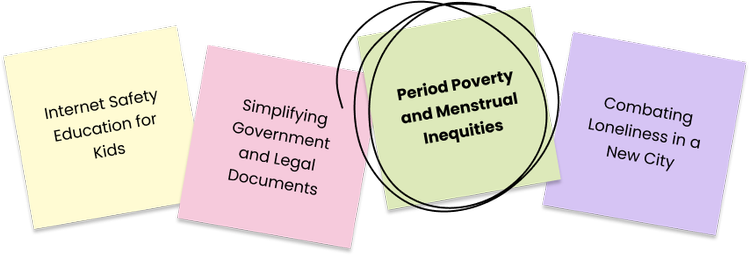
Recognizing the evolving landscape of Women's reproductive health legislation and widespread dissatisfaction with current solutions to menstrual inequities, we focused on 'period poverty’ -- an ongoing challenge lacking effective solutions, particularly impacting those from under-served and vulnerable communities.
“Inadequate access to menstrual hygiene tools and education, including but not limited to sanitary products, washing facilities, and waste management” -
🏳️🌈 Not everyone who menstruates is a woman and not all women menstruate!
With limited time and resources, we omitted primary research. We dedicated the first 2 hours to conducting secondary and market research as thoroughly as possible, allowing us to still familiarize ourselves with the problem space, stakeholders, and existing solutions. Findings were organized into key ideas and themes.
Research Discoveies
Secondary research demonstrated the complexity of period poverty as an issue with its impact extending well beyond a regular inconvenience, with detrimental impact to one’s social, mental, and financial well-being. This issue extends beyond one group of people, affecting many underserved and underrepresented communities.
of Women
of Low Income & Homeless
People of Color
Due to use of unsafe alternatives such as cloth and tissues
Young adults are more likely to have a lower perception of self
As many as 1 in 4 miss opportunities due to these reasons
“DISGUSTING”
“UNHYGIENIC”
“SHAMEFUL”
Due to menstruation being seen as a taboo in many cultures and religions, there is not enough open conversation regarding the struggles of being unable to meet these needs regularly. Many internalize their silent struggles, stagnating the progress towards significant changes.
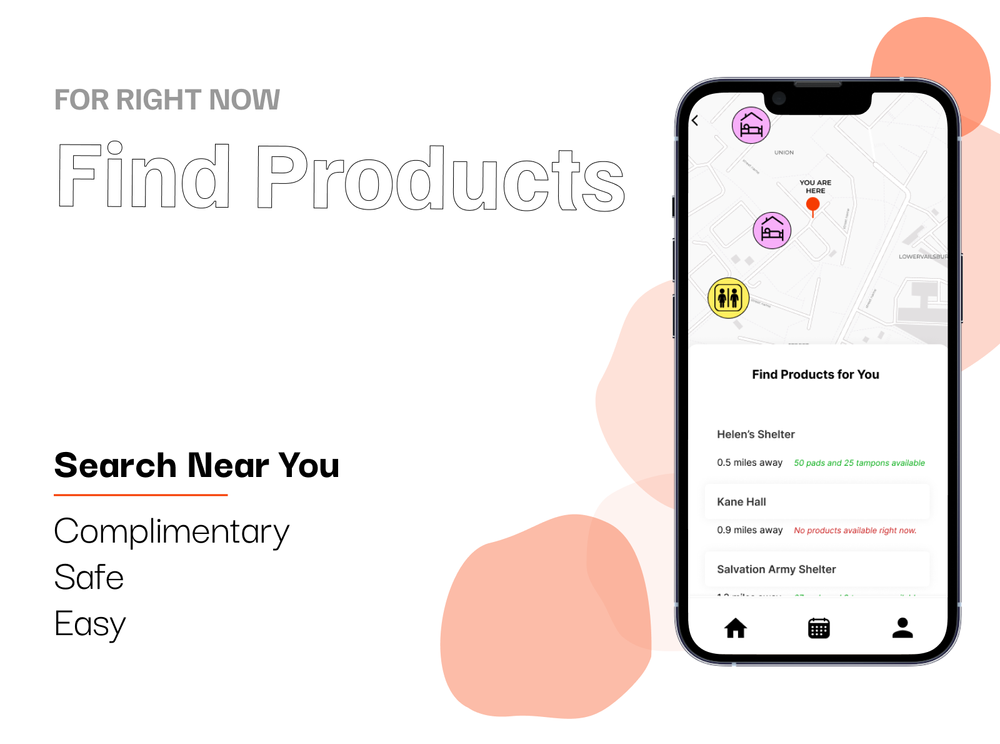
To protect our target users who may be averse to adding their personal address for safety reasons, we included a pickup option at trusted, public locations such as a local Amazon pickup locker. Public access points have high visibility, greatly minimizing the possibility of danger and easing user anxiety.
Menstruation is extremely personal and our target users are a particularly vulnerable group. To keep user’s sensitive health data safe, we will be using a fully protected security system by implementing a multi-layered security strategy that secures the data itself, the access pathways, and the data infrastructures.
In the settings, users have the option of completely removing their health data and delivery address from our databases anytime. Users can also review what data is being accessed by us and how it is being used.
We avoided using direct blood imagery and reds as it is often associated with negative imagery, such as violence, aggression, and danger. To be inclusive of the different types of menstruators, we avoided stereotypically feminine color such as pinks. Menstruators don’t fit within any one mold, and our app aims to reaffirm this idea.
Our primary concern was how we can protect these menstrual resources from being abused by bad actors with malicious intent. We thought of various forms of verification checks such as requiring income verification, but we quickly came to realize that this introduces another barrier to care for our intended users. Whether it was the complete exclusion of those without income or the additional time required to access products due to verification, all possibilities reduced accessibility. Rather than solve a problem, we would have exacerbated the pre-existing issue. Thus, we decided to drop the proof of need. While bad actors are always a possibility, we chose to believe in society’s innate good to be able to aid any who need it.
The app requires accurate inventory amounts so that users can reliably use our app. Inventory checks will be essential so that no user makes a trip for resources only to be met with nothing. To incentivize inventory checks, we will have it be conducted primarily by community volunteers, with the key target demographic being high school students who need service hours. Optionally, users can self-report data on the app (i.e. how many products they took, if certain products are out of stock, etc.).
To sustain our business, we determined it would be appropriate to register as a non-profit organization and apply for government funding and external grants. As this app is not designed with profit in mind, leveraging grants and funds is the best way to gather any necessary funding.
The service is designed around a partnership model that extends beyond government funding and grants. We proposed collaborating with Flo, a widely used menstrual health app, and local charities to supply menstrual product and offset delivery costs.
This partnership creates mutual value for both organizations and the users. Within our app, users can optionally connect their Flo account, allowing them to receive automatic product deliver or pickup based on predicted menstrual cycle. In return, we would promote Flo as a trusted menstrual health resource, providing the company with an additional channel for user engagement and retention.
From a user’s perspective, this integration reduces cognitive load of planning ahead by automatically delivering their products. It also connects users with a credible platform for tracking and educating themselves on their menstrual health, empowering them to be proactive in their menstrual health.
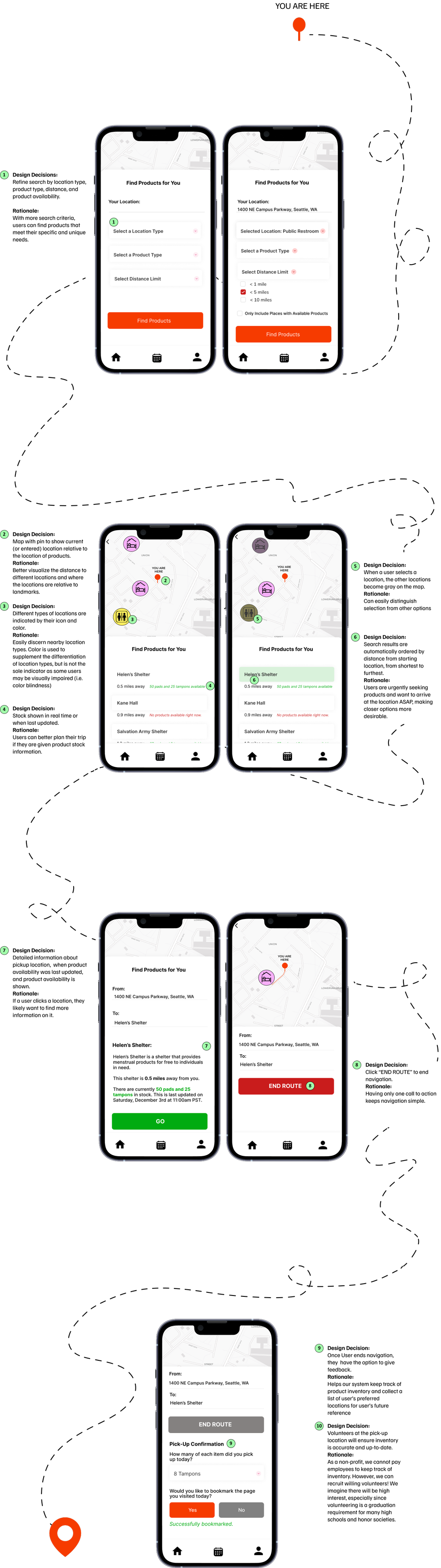
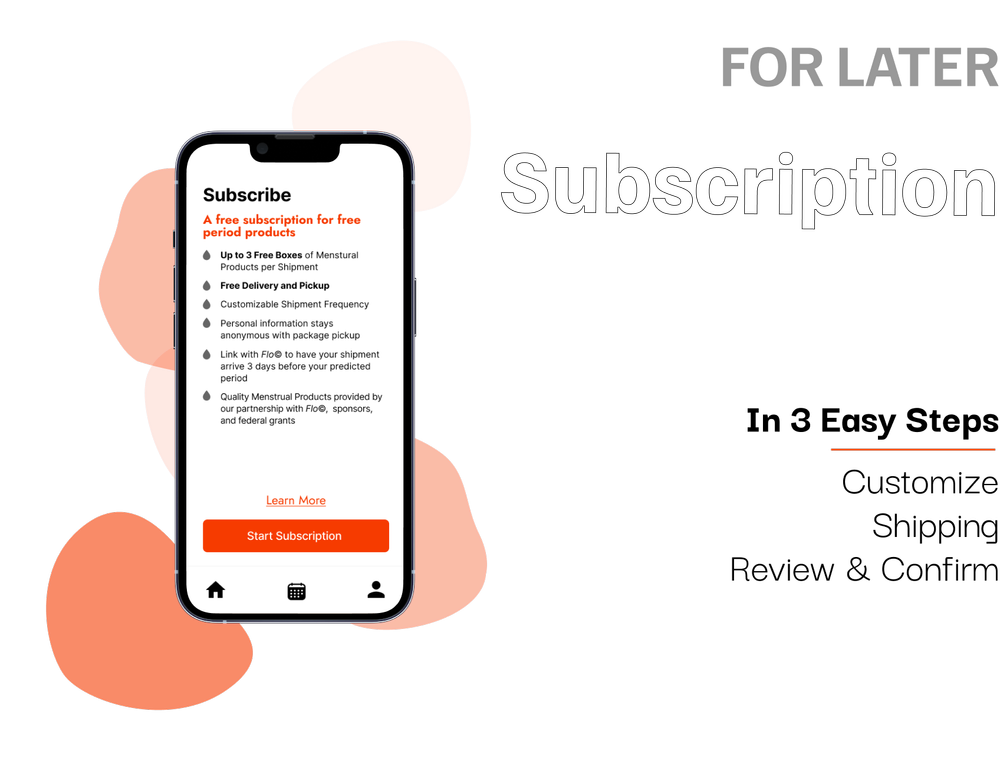
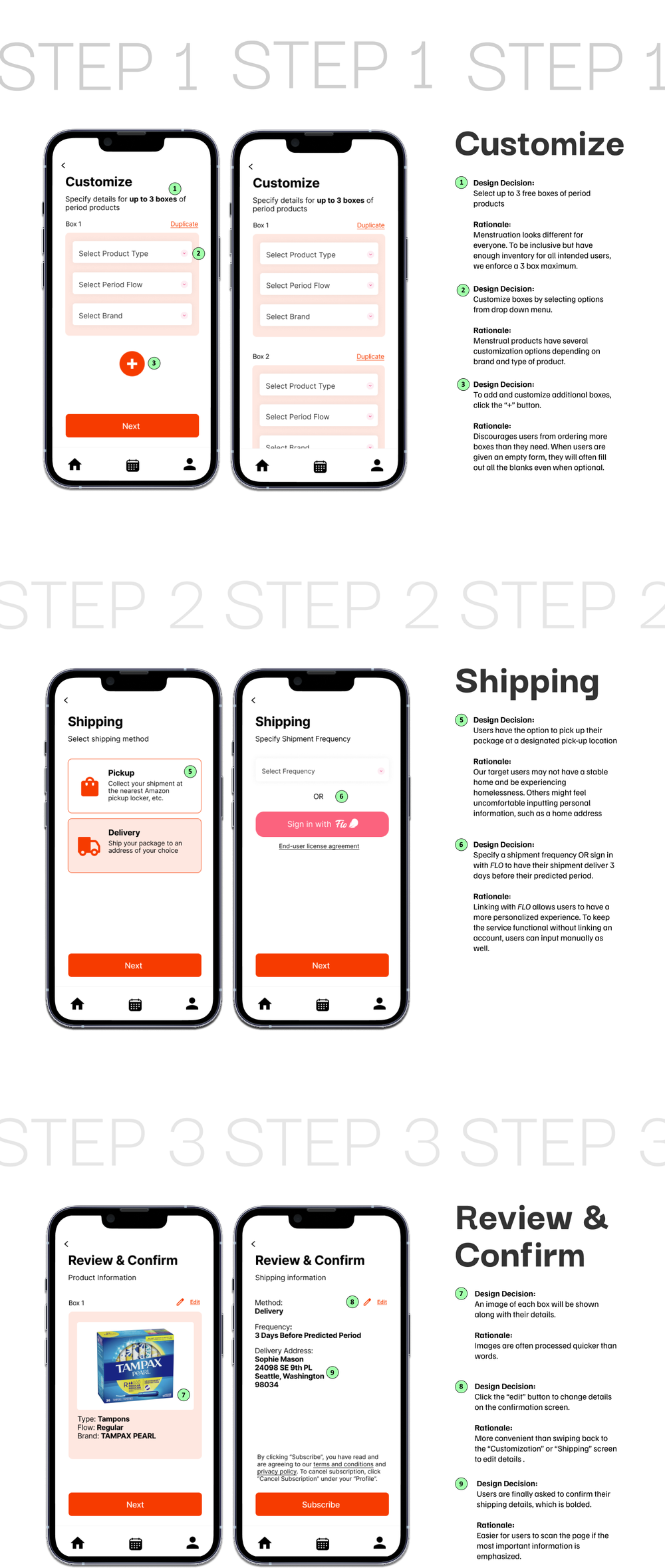
Final Solution
Key Design Decisions
Plan ahead and prioritize tasks to successfully navigate time constraints
Up until now, I’ve had anywhere between 3 months ~ 1 year to complete each design project. This time, we were tasked with creating a solution in under 12 hours. We immediately knew our usual design approach had to be modified for success.
We omitted user testing and usability testing. While these steps provide critical insight into users’ complex needs, mindset, and preferences, we didn’t have timely access to these users . Compromises had to be made during high-fidelity prototyping as well. During the final two hours of the challenge, we recognized it wouldn’t be possible to design all the features we initially planned. We decided to forego less important UI features, such as designing a detailed profile page.
Plan ahead and prioritize tasks to successfully navigate time constraints
This experience emphasized the importance of considering the impact of our design decisions on indirect stakeholders, such as the company. For instance, the guest industry professionals encouraged us to devise a business model that is financially sustainable in the long-term.
Selena Ando
11th Annual University of Washington’s Women in Informatics (WINFO) Hackathon
User Persona
Affinity Diagram Maps
Low to High Fidelity Wireframes
High Fidelity Prototype
MVP
Video Presentation
Secondary Research
Ideation
Low-Fidelity Prototyping
High-Fidelity Prototyping
Best Impact Award
Problem Context
“As we look around us, we examine problems from various perspectives to reframe our preconceptions, build better products and services, and innovate to make the world a better place.”
- Women in Informatics (WINFO) Team
Selecting a Problem Space
Recognizing the evolving landscape of Women's reproductive health legislation and widespread dissatisfaction with current solutions to menstrual inequities, we focused on 'period poverty’ -- an ongoing challenge lacking effective solutions, particularly impacting those from under-served and vulnerable communities.
“Inadequate access to menstrual hygiene tools and education, including but not limited to sanitary products, washing facilities, and waste management” -
🏳️🌈 Not everyone who menstruates is a woman and not all women menstruate!
With limited time and resources, we omitted primary research. We dedicated the first 2 hours to conducting secondary and market research as thoroughly as possible, allowing us to still familiarize ourselves with the problem space, stakeholders, and existing solutions. Findings were organized into key ideas and themes.
Research Discoveies
Secondary research demonstrated the complexity of period poverty as an issue with its impact extending well beyond a regular inconvenience, with detrimental impact to one’s social, mental, and financial well-being. This issue extends beyond one group of people, affecting many underserved and underrepresented communities.
of Women
of Low Income & Homeless
People of Color
Due to use of unsafe alternatives such as cloth and tissues
Young adults are more likely to have a lower perception of self
As many as 1 in 4 miss opportunities due to these reasons
Due to menstruation being seen as a taboo in many cultures and religions, there is not enough open conversation regarding the struggles of being unable to meet these needs regularly. Many internalize their silent struggles, stagnating the progress towards significant changes.
“DISGUSTING”
“UNHYGIENIC”
“SHAMEFUL”
Key Design Decisions
To protect our target users who may be averse to adding their personal address for safety reasons, we included a pickup option at trusted, public locations such as a local Amazon pickup locker. Public access points have high visibility, greatly minimizing the possibility of danger and easing user anxiety.
Menstruation is extremely personal and our target users are a particularly vulnerable group. To keep user’s sensitive health data safe, we will be using a fully protected security system by implementing a multi-layered security strategy that secures the data itself, the access pathways, and the data infrastructures.
In the settings, users have the option of completely removing their health data and delivery address from our databases anytime. Users can also review what data is being accessed by us and how it is being used.
We avoided using direct blood imagery and reds as it is often associated with negative imagery, such as violence, aggression, and danger. To be inclusive of the different types of menstruators, we avoided stereotypically feminine color such as pinks. Menstruators don’t fit within any one mold, and our app aims to reaffirm this idea.
Our primary concern was how we can protect these menstrual resources from being abused by bad actors with malicious intent. We thought of various forms of verification checks such as requiring income verification, but we quickly came to realize that this introduces another barrier to care for our intended users. Whether it was the complete exclusion of those without income or the additional time required to access products due to verification, all possibilities reduced accessibility. Rather than solve a problem, we would have exacerbated the pre-existing issue. Thus, we decided to drop the proof of need. While bad actors are always a possibility, we chose to believe in society’s innate good to be able to aid any who need it.
The app requires accurate inventory amounts so that users can reliably use our app. Inventory checks will be essential so that no user makes a trip for resources only to be met with nothing. To incentivize inventory checks, we will have it be conducted primarily by community volunteers, with the key target demographic being high school students who need service hours. Optionally, users can self-report data on the app (i.e. how many products they took, if certain products are out of stock, etc.).
To sustain our business, we determined it would be appropriate to register as a non-profit organization and apply for government funding and external grants. As this app is not designed with profit in mind, leveraging grants and funds is the best way to gather any necessary funding.
The service is designed around a partnership model that extends beyond government funding and grants. We proposed collaborating with Flo, a widely used menstrual health app, and local charities to supply menstrual product and offset delivery costs.
This partnership creates mutual value for both organizations and the users. Within our app, users can optionally connect their Flo account, allowing them to receive automatic product deliver or pickup based on predicted menstrual cycle. In return, we would promote Flo as a trusted menstrual health resource, providing the company with an additional channel for user engagement and retention.
From a user’s perspective, this integration reduces cognitive load of planning ahead by automatically delivering their products. It also connects users with a credible platform for tracking and educating themselves on their menstrual health, empowering them to be proactive in their menstrual health.
Final Solution
Plan ahead and prioritize tasks to successfully navigate time constraints
Up until now, I’ve had anywhere between 3 months ~ 1 year to complete each design project. This time, we were tasked with creating a solution in under 12 hours. We immediately knew our usual design approach had to be modified for success.
We omitted user testing and usability testing. While these steps provide critical insight into users’ complex needs, mindset, and preferences, we didn’t have timely access to these users . Compromises had to be made during high-fidelity prototyping as well. During the final two hours of the challenge, we recognized it wouldn’t be possible to design all the features we initially planned. We decided to forego less important UI features, such as designing a detailed profile page.
Plan ahead and prioritize tasks to successfully navigate time constraints
This experience emphasized the importance of considering the impact of our design decisions on indirect stakeholders, such as the company. For instance, the guest industry professionals encouraged us to devise a business model that is financially sustainable in the long-term.
Selena Ando
11th Annual University of Washington’s Women in Informatics (WINFO) Hackathon
User Persona
Affinity Diagram Maps
Low to High Fidelity Wireframes
High Fidelity Prototype
MVP
Video Presentation
Secondary Research
Ideation
Low-Fidelity Prototyping
High-Fidelity Prototyping
Best Impact Award
Problem Context
“As we look around us, we examine problems from various perspectives to reframe our preconceptions, build better products and services, and innovate to make the world a better place.”
- Women in Informatics (WINFO) Team
Selecting a Problem Space
Recognizing the evolving landscape of Women's reproductive health legislation and widespread dissatisfaction with current solutions to menstrual inequities, we focused on 'period poverty’ -- an ongoing challenge lacking effective solutions, particularly impacting those from under-served and vulnerable communities.
“Inadequate access to menstrual hygiene tools and education, including but not limited to sanitary products, washing facilities, and waste management” -
🏳️🌈 Not everyone who menstruates is a woman and not all women menstruate!
With limited time and resources, we omitted primary research. We dedicated the first 2 hours to conducting secondary and market research as thoroughly as possible, allowing us to still familiarize ourselves with the problem space, stakeholders, and existing solutions. Findings were organized into key ideas and themes.
Research Discoveries
Secondary research demonstrated the complexity of period poverty as an issue with its impact extending well beyond a regular inconvenience, with detrimental impact to one’s social, mental, and financial well-being. This issue extends beyond one group of people, affecting many underserved and underrepresented communities.
of Women
of Low Income & Homeless
People of Color
Due to use of unsafe alternatives such as cloth and tissues
Young adults are more likely to have a lower perception of self
As many as 1 in 4 miss opportunities due to these reasons
Due to menstruation being seen as a taboo in many cultures and religions, there is not enough open conversation regarding the struggles of being unable to meet these needs regularly. Many internalize their silent struggles, stagnating the progress towards significant changes.
“DISGUSTING”
“UNHYGIENIC”
“SHAMEFUL”
Key Design Decisions
To protect our target users who may be averse to adding their personal address for safety reasons, we included a pickup option at trusted, public locations such as a local Amazon pickup locker. Public access points have high visibility, greatly minimizing the possibility of danger and easing user anxiety.
Menstruation is extremely personal and our target users are a particularly vulnerable group. To keep user’s sensitive health data safe, we will be using a fully protected security system by implementing a multi-layered security strategy that secures the data itself, the access pathways, and the data infrastructures.
In the settings, users have the option of completely removing their health data and delivery address from our databases anytime. Users can also review what data is being accessed by us and how it is being used. Transparency is key when dealing with sensitive data, and our intention is to give users complete agency over what they provide.
We avoided using direct blood imagery and reds as it is often associated with negative imagery, such as violence, aggression, and danger. To be inclusive of the different types of menstruators, we avoided stereotypically feminine color such as pinks. Menstruators don’t fit within any one mold, and our app aims to reaffirm this idea.
Our primary concern was how we can protect these menstrual resources from being abused by bad actors with malicious intent. We thought of various forms of verification checks such as requiring income verification, but we quickly came to realize that this introduces another barrier to care for our intended users. Whether it was the complete exclusion of those without income or the additional time required to access products due to verification, all possibilities reduced accessibility. Rather than solve a problem, we would have exacerbated the pre-existing issue. Thus, we decided to drop the proof of need. While bad actors are always a possibility, we chose to believe in society’s innate good to be able to aid any who need it.
The app requires accurate inventory amounts so that users can reliably use our app. Inventory checks will be essential so that no user makes a trip for resources only to be met with nothing. To incentivize inventory checks, we will have it be conducted primarily by community volunteers, with the key target demographic being high school students who need service hours. Optionally, users can self-report data on the app (i.e. how many products they took, if certain products are out of stock, etc.).
To sustain our business, we determined it would be appropriate to register as a non-profit organization and apply for government funding and external grants. As this app is not designed with profit in mind, leveraging grants and funds is the best way to gather any necessary funding.
The service is designed around a partnership model that extends beyond government funding and grants. We proposed collaborating with Flo, a widely used menstrual health app, and local charities to supply menstrual product and offset delivery costs.
This partnership creates mutual value for both organizations and the users. Within our app, users can optionally connect their Flo account, allowing them to receive automatic product deliver or pickup based on predicted menstrual cycle. In return, we would promote Flo as a trusted menstrual health resource, providing the company with an additional channel for user engagement and retention.
From a user’s perspective, this integration reduces cognitive load of planning ahead by automatically delivering their products. It also connects users with a credible platform for tracking and educating themselves on their menstrual health, empowering them to be proactive in their menstrual health.
Final Solution
Plan ahead and prioritize tasks to successfully navigate time constraints
Up until now, I’ve had anywhere between 3 months ~ 1 year to complete each design project. This time, we were tasked with creating a solution in under 12 hours. We immediately knew our usual design approach had to be modified for success.
We omitted user testing and usability testing. While these steps provide critical insight into users’ complex needs, mindset, and preferences, we didn’t have timely access to these users . Compromises had to be made during high-fidelity prototyping as well. During the final two hours of the challenge, we recognized it wouldn’t be possible to design all the features we initially planned. We decided to forego less important UI features, such as designing a detailed profile page.
Plan ahead and prioritize tasks to successfully navigate time constraints
This experience emphasized the importance of considering the impact of our design decisions on indirect stakeholders, such as the company. For instance, the guest industry professionals encouraged us to devise a business model that is financially sustainable in the long-term.